

What Do You Actually Talk About with a Health Psychologist for Chronic Pain?
Content:
Pain Doesn't Always Mean Danger
Learning Psychological Safety
Understanding the Thoughts That Accompany Pain
Grieving the Life That Changed
Mindfulness Isn't Always About Closing Your Eyes
Self-Compassion Before Self-Improvement
Living a Meaningful Life Alongside Pain
Therapy Isn't About Eliminating Every Difficult Feeling
One of the most common questions I hear is: "What do people actually talk about in therapy for chronic pain?"
It's a fair question. If you've never seen a Health Psychologist before, it can be difficult to imagine how conversations could possibly help when you're living with physical pain.
The short answer is this: we don't spend our time convincing you that your pain isn't real.
Pain is real. Your suffering is real. The frustration, grief, uncertainty and exhaustion that often accompany persistent pain are real too.
Instead, our conversations explore how pain has affected your life, how your nervous system has learned to respond to pain, and how we might help you gradually reclaim parts of your life that pain has taken away. Every person's journey is unique, but here are some of the themes we commonly explore together.
Understanding Your Relationship with Pain
Most people have spent years talking about where their pain is and how much it hurts. Those conversations are important. But sometimes we also ask different questions.
What has pain stopped you from doing?
What has pain asked you to give up?
How has pain changed your relationships?
Who were you before the pain?
Who are you becoming now?
For some people, pain has quietly become the centre of their world. For others, pain is still present every day, yet they've found ways to continue living according to what matters most to them. Neither experience is right or wrong. Understanding your own relationship with pain often provides important clues about where therapy can help.
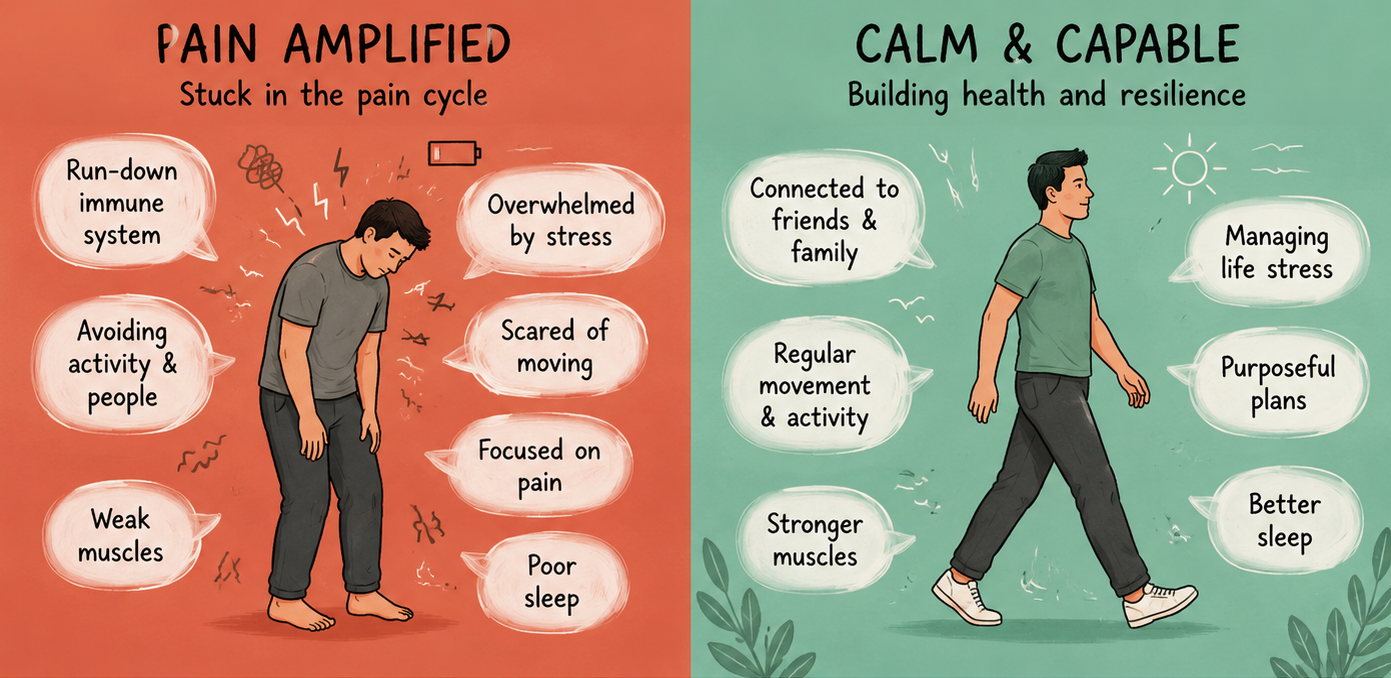
Learning How the Nervous System Responds to Pain
Many people understandably assume that pain always means their body is being damaged. While this is often true in the early stages of an injury, persistent pain is more complex. Sometimes the nervous system becomes highly sensitive, the alarm system becomes overprotective, and the brain and body continue producing pain even though the tissues themselves may no longer be in danger.
This doesn't mean the pain is "imaginary." It means the nervous system has become exceptionally good at protecting you. One of our goals is helping you understand when your body is signalling genuine danger, and when it's simply signalling heightened protection. That distinction can reduce fear and make rehabilitation feel more achievable.
Pain Doesn't Always Mean Danger
One of the most empowering discoveries for many people is this: pain always means discomfort, but it doesn't always mean danger.
Your physiotherapist, for example, may reassure you that although an exercise is uncomfortable, it remains safe and important for your recovery. When the brain automatically interprets every painful sensation as a threat, it's understandable that anxiety rises: the body tenses, breathing changes, attention narrows, and pain often intensifies as a result.
Learning to separate discomfort from danger is often what interrupts that cycle, building on the nervous system understanding above.
Learning Psychological Safety
When you've lived with pain for months or years, your nervous system can begin expecting danger everywhere. Sometimes even sitting, walking or bending can feel threatening. Part of therapy involves helping your nervous system rediscover moments of safety.
Importantly, safety doesn't necessarily mean being completely relaxed. It means recognising that even while pain is present, you still have choices. You can pause. You can rest. You can continue. You can ask for support. You can gently shift your attention.
Safety comes from having options, not from waiting until pain disappears.
Why we stop moving, and why that backfires
Once pain shows up, it's natural to avoid whatever movement seems connected to it, hoping to protect the area. Over time, avoided movement leads to stiffness, weaker muscles, and a nervous system that's had less and less evidence that moving is actually safe, so it stays cautious. Meanwhile, the original injury may have long since healed.
A common version of this: someone hurts their back and is told bending is risky. Months later, the back has healed, but they still move stiffly, avoiding bending in ways that have nothing to do with any current injury and everything to do with a brain still treating bending as dangerous. Retraining that belief, gently and gradually, is usually what brings movement back, not more rest.
If you've been putting off rehab exercises because you're scared of making things worse, that fear makes complete sense. The real question underneath it is usually this: is this helpful pain, or unhelpful pain?
Understanding the Thoughts That Accompany Pain
Pain doesn't only affect the body. It also shapes the stories we tell ourselves. Some common thinking patterns include:
"If I can't do it perfectly, there's no point trying."
"I should be able to cope better."
"Because I feel terrible today, today is going to be a disaster."
"If I make the pain worse, I'll never recover."
These thoughts aren't signs of weakness. They're understandable attempts by the brain to keep you safe. Together we explore whether these thoughts are helping you move toward the life you want, or unintentionally keeping you stuck.
Grieving the Life That Changed
One of the most overlooked aspects of persistent pain is grief. Many people aren't only grieving their body. They're grieving:
the career they imagined
the hobbies they loved
their independence
their confidence
the parent they wanted to be
the partner they hoped to become
Some people also grieve years of feeling dismissed or misunderstood by healthcare professionals. These losses deserve acknowledgement. Healing isn't about pretending those losses never happened. It's about making space for them while slowly rebuilding a meaningful life.
If any of this feels familiar, you don't have to carry it alone. Whenever you're ready,
Mindfulness Isn't Always About Closing Your Eyes
When people hear the word "mindfulness," they often imagine sitting quietly and paying close attention to their body. For some people, this is incredibly helpful. For others, particularly those whose nervous system has become highly sensitive, focusing intensely on painful sensations can initially feel overwhelming.
In these situations, we may gently broaden attention instead. Rather than focusing inward, we might notice:
the sounds around us
the colours in the room
the feeling of our feet on the floor
the movement of the air
the rhythm of our breathing
There isn't one correct way to practise mindfulness. The goal isn't to force yourself to notice pain. The goal is developing the flexibility to move your attention where it is most helpful in that moment.
Self-Compassion Before Self-Improvement
Many people living with chronic pain become incredibly self-critical:
"I should be coping better."
"I'm letting everyone down."
"I used to be stronger than this."
Therapy often begins by changing the conversation we have with ourselves. Self-compassion isn't about giving up. It's about recognising that you're already carrying something difficult.
Instead of asking, "Why can't my body do what it used to?" we might also ask, "What has my body still allowed me to experience today?" Sometimes that answer is surprisingly meaningful.
Living a Meaningful Life Alongside Pain
One of the biggest misconceptions about pain psychology is that acceptance means liking pain or giving up hope. It doesn't.
Acceptance means recognising that fighting every painful sensation often consumes enormous amounts of energy. Rather than spending every day waiting for life to begin once pain disappears, therapy explores how life can gradually become richer even while pain remains part of the picture. That might mean:
reconnecting with family
returning to meaningful work
walking around the block
dancing again
travelling
laughing
creating
helping others
Pain may still be there. But it no longer gets the final say.
Therapy Isn't About Eliminating Every Difficult Feeling
There will still be painful days. There will still be frustration, sometimes sadness, sometimes grief, sometimes fear.
The goal isn't to become someone who never struggles. The goal is becoming someone who has more flexibility, more confidence and more trust in their ability to respond to whatever pain brings. Over time, many people discover that while the pain itself may not completely disappear, their life gradually becomes much bigger than the pain.
If You're Wondering Whether Pain Psychology Could Help
You don't need to have all the answers before reaching out. Many people come to therapy simply feeling exhausted after months or years of trying to manage persistent pain on their own.
Together, we can begin exploring your experience, understanding how pain has shaped your life, and identifying practical, evidence-based ways to help you move toward the life that's important to you, one step at a time.
I'm Gordon Wong, an AHPRA-endorsed Health Psychologist and the psychologist behind Socra Hub, a telehealth practice supporting adults across Australia.
